

Five Plus One: How It Started, How It’s Going, and A Few Things I Know For Sure
Obligatory milestone post. Just one year late.

First, for the record, I’ve been using the em dash since I started writing newsletters 2018 so don’t come at me saying this was written by AI. I have a deep love for the em dash (and semicolon and ellipses for that matter) and will continue to use these clever little devices in my writing. Rest assured that this—and every—newsletter is from my brain. Please excuse human errors and my tendency for passive voice. Now, let’s get to it.
Six years ago this month, rekon Retail® turned 5 years old. (yes, it’s taken me an extra year to finish my five-year newsletter which is further evidence this was written by just me). If you’re doing the math, this company started in the middle of the pandemic: July of 2020 to be exact. At that time all stores that weren’t “essential” (basically grocery and pharmacy) were still closed and the ecommerce community along with VCs, analysts and even some “retail experts” were declaring the death of all physical retail.
I didn’t buy it. I wasn’t sure when they’d reopen but I knew that stores would always be a thing. And I also knew brands would continue to need expertise and execution when it came to entering and expanding their retail footprints. I knew from my time at Warby Parker and Outdoor Voices that most ecommerce-only brands lacked the internal knowledge and resources to build stores efficiently and scalably on their own—and the vision for a new type of agency was born. The original tagline of then Kondrat Retail LLC was to: Build, expand, and run retail environments that drive sales and create loyal customers. Not bad for a non-branding person.
After a few small projects centered around clientelling while retail was still shut down, I booked my first client. It was a strategy project for a new store concept for a developer in Rhode Island. I assembled a team–store design, marketing, product, operations–we worked together for almost a year and though the developer pivoted to work on something else and the concept never came to fruition, the viability of what soon became rekon Retail was solidified enough for me.
To move quickly through the next 4 years, starting in early 2021 things picked up with more brands wanting to open stores but not knowing where to start, or brands with existing stores wanting to expand but needing bandwidth. In 2022 Kondrat Retail rebranded as rekon Retail® and officially became an agency (which you can read about in a previous post here).
Since this is a 5 (+1) year anniversary newsletter I would be remiss if I didn’t do some sort of “Top 5 things I’ve learned in the last 5 years” or some such post. But if I’m being honest, it’s not so much what’s been learned as it is what’s been confirmed. So I give you:
Top 5 things I already knew…and still know…after 5 (+1) years building retail for brands.
1. Your first store isn’t just about ROI. It’s about alignment.
I said what I said. The first store is rarely your most profitable—at least at first—but it is the one that gets the key stakeholders and larger organization aligned. Physical retail is a forcing function. It exposes operational gaps, clarifies the merchandising POV, and reveals the true brand values. If you pay attention to it, that is. Visit the store often, talk to the frontline team, listen to what customers are saying, and take those learnings to improve the customer experience both online and offline.
The store isn’t just for your customers. It’s for your internal team to experience first-hand what the brand feels like irl.
2. Location, location, location. Maybe not the way you think.
Quantitative data can tell you where people shop, but qualitative context tells you why. Both are important when considering where to open stores. Generally, the most successful brands follow this trajectory:
Build your first store in your backyard. Always. Don’t build it across the country–certainly not across the world. It needs to be a place where key stakeholders will visit often to observe, evaluate and collect feedback.
The next 10 or so stores should be where your customers are. As in where they actually are–not look-a-like customers with the same psychographic and demographic profile. Look at your zip code data and go to those places.
Moving beyond the first 10 you can look at where your customers should be. By now you should have enough data to create reasonably robust customer personas. Overlay this with available population data like HHI, hobbies, professions and interests and you now have a paint by numbers heat map of where to put your next 10-20+ stores.
Caveats and exceptions always exist. Some brands have had incredible success in places the models wouldn’t recommend, simply because the vibe, flow, and brand resonance were right. Don’t just follow the foot traffic–also follow your customer’s gps.
3. Underestimating ops will kill your store faster than bad design.
Lighting is sexy. Tile choices are fun. These things get customers through the door and give a physical sense of a brand’s personality. They are important, but even with the most thoughtful, compelling design, your staff can still be frustrated and your store may not be profitable. The reason? Inattention to the ever important operations.
I know. Ops isn’t sexy. It’s invisible so why should brands spend time and valuable dollars on things that customers don’t see? Well, when a store is operationally sound (integrated systems for inventory management, clear documented processes and procedures for everyday occurrences that keep the business running smoothly, robust communication channels so everyone knows who to contact when things go sideways) customers will never know. But, when operations are poor, it is all that customers will notice–no matter how expensive that decorative chandelier was.
Make no mistake, great retail is 80% logistics, 20% layout. Don’t get distracted by the 20.
4. The best retail experiences feel familiar, not foreign.
I’ve worked across many product categories—furniture, homegoods, eyewear, technology, athleisure, fashion, upscale convenience store, footwear, jewelry—and the best experiences leave the elements that customers expect in tact, but add something unique, unexpected and solve a real painpoint in the customer journey. They take existing retail formats and make small, strategic improvements that enhance the specific customer experience that the brand needs to deliver.
As Nintendo’s Gunpei Yokoi taught us with “lateral thinking with withered technology“—sometimes the most innovative solutions come from using what already works and making it work better for your specific customer.
Take what is arguably the first DTC brand, Bonobos. The first Bonobos “store” (showroom, really) did not exist for customers to leave with any merchandise. That seemed so crazy at the time, and eventually the brand did start stocking merch for carry-out in its stores, but Bonobos was not solving the problem of men being able to leave with their items. They were solving the problem of knowing your fit.
When you think about it, it was a mass experiment in clientelling. The second a customer engaged with a Bonobos associate, they were automatically made a client. They had a profile where all of their sizes and styles were recorded and the associate could email them about updates and new styles. Many men had never received a shopping experience like this ever before.
Bonobos didn’t come up with some new innovative way to display pants and shirts, it didn’t add holograms or futuristic tech to its fitting rooms, it just tweaked one element of the way that customers shopped for clothes. By inserting a level of service not previously known, it addressed a problem many customers perhaps didn’t realize they had.
5. Physical retail is the best retention channel no one is measuring.
Stores should drive awareness and net-new customer acquisition. Let me just say that and get it out of the way. But, what is not talked about or measured enough is how stores can become a brand’s best customer retention tool.
Most brands track the percentage of new versus the percentage of existing customers purchasing from their physical stores. Some track the repeat purchase rate across channels once a first purchase is made in store. What everyone should be tracking is the customer lifetime value of the store + ecommerce customer (multi-channel) versus the single channel customer. Because this is where the store has the ability to not only convert, but to also connect with a brand’s customer base.
If a great interaction happens in a store, but no-one from HQ knows about it, does it make an impact? The brands that find ways to collect and disseminate customer feedback—both good and bad—throughout the org and up to the decision makers are the ones that will keep customers returning.
By the Numbers:
In the last 5 (+1) years, rekon has…
Opened 50+ stores for DTC brands across categories including apparel, accessories, footwear, sporting goods, homegoods and beauty to name a few
Operated projects in 41 U.S. cities
Managed the design/build process more than 50,000 sq ft of retail space
Helped brands hire more than 100 frontline retail team members
Not bad for a company that started at a time when retail was surely dead. Hence our trademark Retail is Alive®
What the Next Five(ish) Years Hold
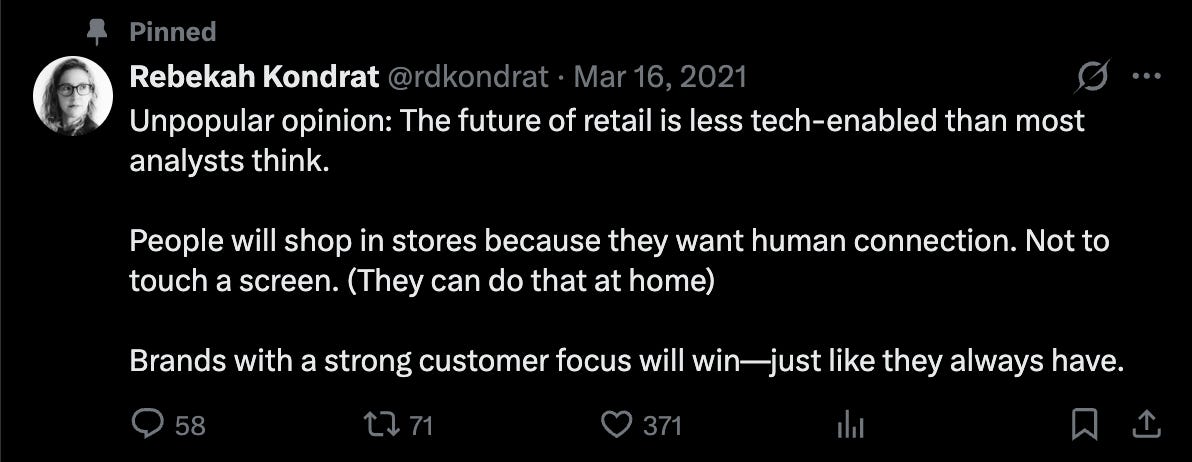
I am starting to see a retail landscape where successful DTC brands stop trying to recreate their digital experience in a physical space and start creating physical experiences that address customer needs that digital simply can’t.
The winners will be brands that understand retail isn’t just about selling products in stores—it’s about creating human connections that drive long-term customer value across all channels.
If that’s you, or someone you know, I’d love to talk.
Thanks for following along for the first five, well six actually, years.